
A technician asks what was previously repaired in the dishwasher, but the owner can find only an invoice describing the work as “service”. It is unclear which part was replaced or whether the call-out concerned the same symptom. Paying for the repair does not, therefore, resolve the organisational issue.
How can you organise records for appliances and their servicing in an apartment? For each important appliance, it is worth keeping a single record that brings together its identification details, purchase information and chronological service history. It is just as important to specify who updates the record after each service call. The aim is not to count the furnishings, but to retain the information needed for the next decision or contractor visit.
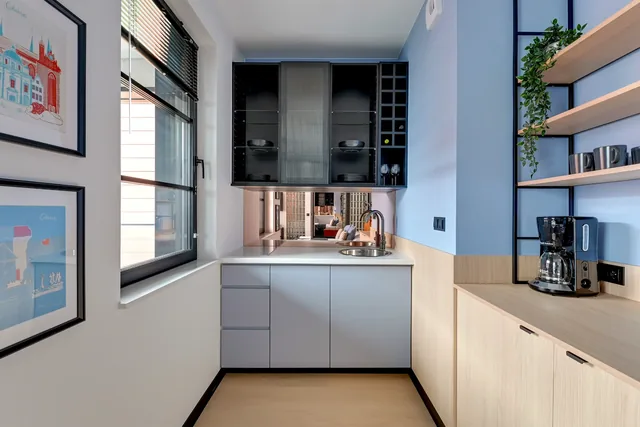
Kitchenette in a DOKI Living apartment finished by Grand. Image for illustrative purposes.
Identify the appliance, not just its place in the kitchen
The description “dishwasher in the apartment” is convenient in conversation, but it is not enough for record-keeping. Give the appliance a simple identifier, such as “apartment A — dishwasher 01”, and link it to the brand, full model designation and serial number. Include a clear photo of the rating plate, provided it can be taken without dismantling or interfering with the appliance.
Designations vary by manufacturer. Bosch identifies the E-Nr. as the number used to identify an appliance when selecting the right documents, products and services; some services may also require the FD and Z-Nr. 1 In the record, it is worth retaining the field names shown on the appliance rather than reducing all designations to the imprecise label “appliance number”.
If one owner has several similarly equipped apartments, the identical appearance of the appliances should not determine which one a repair is assigned to. The contractor should receive the details of the specific appliance, not a photo of a similar kitchen.
Link the purchase to documents for that specific appliance
Attach the proof of purchase, purchase date, documents received at installation and the relevant manufacturer’s manual to the record. Do not assume that a document in the “Appliances” folder relates to the appliance still in the apartment. When taking over a furnished apartment, compare the markings on the appliances with those in the documentation provided.
Purchase details are also useful when contacting the manufacturer. Electrolux’s guide lists the PNC number, serial number and purchase date from the proof of purchase as information to have ready when making a complaint or requesting a warranty repair. 2 This is an example of the requirements of a specific brand, not a promise that every appliance in an apartment will be covered by a warranty.
If documents are missing, write “proof of purchase not provided” explicitly and state who is trying to obtain it. Missing information is better than a guessed date that may later come to be treated as fact.
Record what happened during the service call, not just “repaired”
The history should distinguish between the symptom reported by the guest, the contractor’s findings and the outcome of the work. In a hypothetical example, a guest reports water under the dishwasher. That does not yet identify the cause. The contractor’s report should explain what they found and what work they carried out.
After each service call, add a brief entry covering:
- the date of the report and visit, and a description of the observed symptom;
- the contractor’s findings, the work carried out and the parts replaced;
- the cost, a link to the billing document and whether the expense was approved;
- the outcome of the contractor’s checks, their recommendations and the status of the case;
- the service company’s name and work order number, if one was assigned.
There is no need to transcribe the entire report. A concise summary linked to the original file is enough. If the technician has not confirmed that the work is complete, mark the case as open—for example, “awaiting part”. Do not mark it “closed” solely because an invoice has been received.
Specify who updates the record after a visit
The contractor describes the work, but someone must assign the report to the right appliance. So designate one person to update the service history: either the owner or an agreed contact responsible for managing the apartment. This prevents the task from falling between the person who booked the visit, the service company and the accounts team.
The simplest process looks like this: the person placing the order provides the appliance identification and any relevant previous entries, the service company supplies a description of the work, and the person maintaining the record logs the outcome and files the documents. If the arrangement includes technical maintenance and cleaning, it is worth agreeing on this process from the outset rather than assuming it will happen automatically.
The service history does not replace the rules for making financial decisions. Who can order further work, and when approval for a repair is required, should be agreed separately. The record shows what happened to the appliance; the agreement specifies who can approve the expense.
Keep guest materials separate from service information
Guests need simple instructions for using the appliances, while contractors need technical details and a record of previous findings. These are different documents. Appliance instructions are used to prepare materials for people staying in the apartment; invoices and repair histories should not be added to them.
Keep service records somewhere accessible to the people managing the apartment, without making them available to all guests. Give the contractor the information needed for the specific work order, not the owner’s entire folder. The key is to be able to find the current record and documents without searching through several email inboxes.
When an appliance is replaced, close its old record but do not delete it
The new appliance should have a new record, even if it occupies exactly the same space. In the old record, note the date it was taken out of service and the reason for replacement; in the new one, record which appliance it replaced. Do not overwrite the serial number, or earlier repairs would appear to belong to the new appliance.
Keeping records this way helps the owner reconstruct expenses and give contractors details of previous service calls. It does not, by itself, determine whether another repair is worthwhile—it provides information for a discussion with the service company and the person managing the apartment.
If you are considering entrusting your apartment to GrandRent, let’s discuss the specific property, its appliances and how documents are handed over after repairs. The initial conversation about entrusting us with rental management is free of charge. The scope of technical maintenance, costs and responsibilities are agreed individually.
Technical sources
The article explains the rules and questions you should ask the operator. Rental results and cooperation terms require analysis of the specific apartment.