
In photos of an empty apartment, the entrance looks spacious. The owner adds a console table, a vase and a decorative coat rack, only to discover when trying to bring in a suitcase that the door is difficult to close. It is worth planning this part of the apartment around the order of tasks after arrival, rather than starting with the decor.
Where should you make room for luggage in a small apartment? Inside the apartment, just beyond the entrance, but outside the door’s swing and the route to the other rooms. This is a place to set down a suitcase temporarily. Plan a separate surface where guests can open it—not necessarily in the hallway. That way, a small entrance does not have to accommodate every function at once.
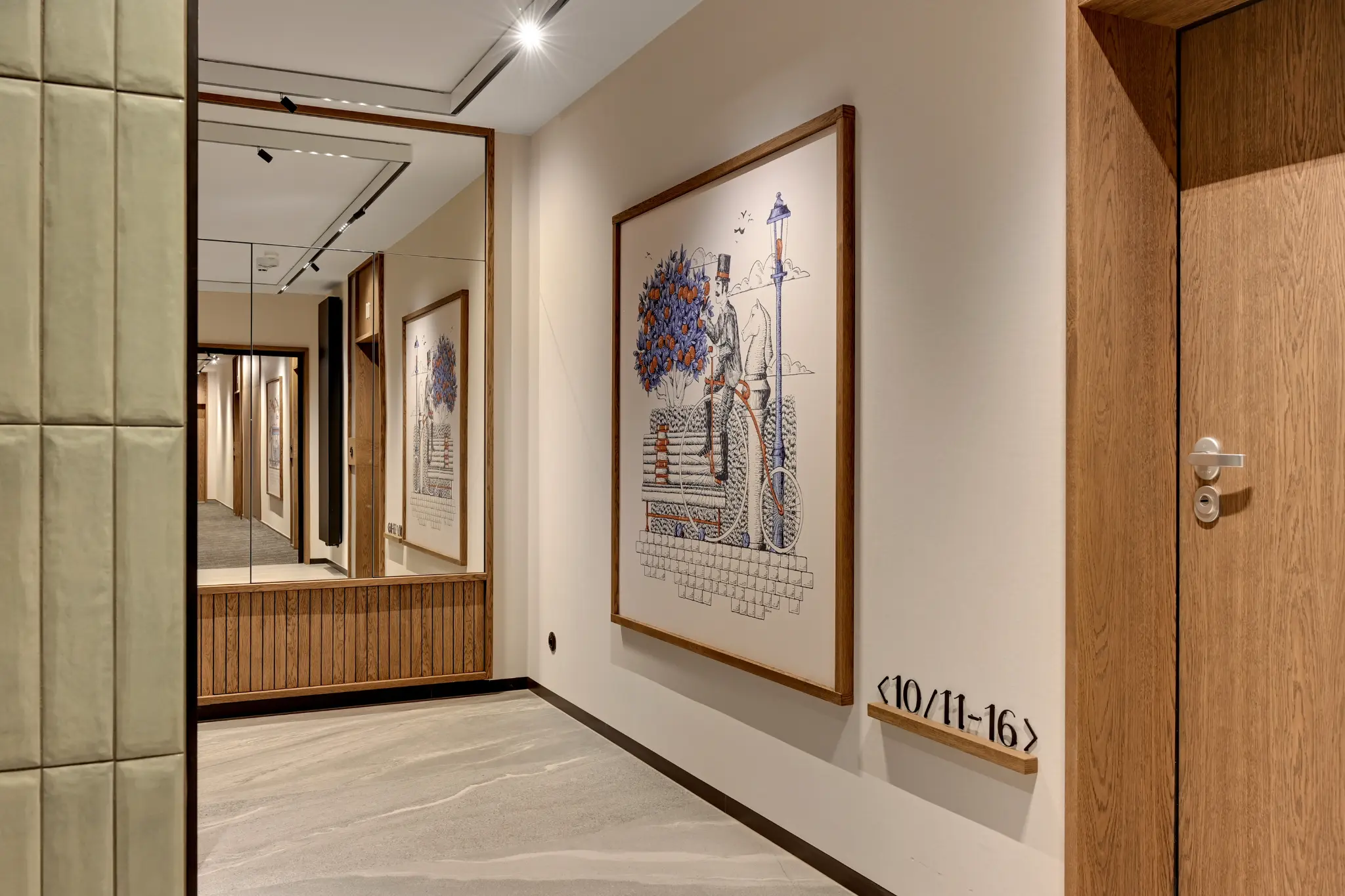
Hallway in the Scala building. Illustrative photo—it does not show a luggage area inside an apartment.
Separate Setting Down a Suitcase from Unpacking
A suitcase standing upright needs a different space from one opened on the floor. At the entrance, it is enough to designate a clearly defined patch of floor beside the built-in units or along a clear wall. Do not instinctively fill it with another shelf. Also check that an extended suitcase handle will not catch on the coat rack and that another person can get inside.
The unpacking area can be in the bedroom, on a luggage rack, or in a clear part of a room. It should allow guests to reach their belongings without blocking the bathroom door. Treat storing an empty suitcase under the bed as an additional option, not the only solution: not every guest unpacks all their luggage straight away.
In a hypothetical studio apartment with a narrow entrance, leaving an alcove empty may be a better choice than installing an eye-catching console table. A console provides a surface, but takes away space for the largest item brought in on arrival.
A Coat and Shoes Should Not Take Up the Same Space
Place the coat rack where guests can take off a coat without stepping back over the threshold. Assess it with a coat hanging on it, not with empty hooks: clothing projects farther out than the wall-mounted fixture itself. If shoes are stored below, make sure a long coat does not rest on them.
Set aside an easily accessible spot at floor level for shoes in use. A closed shoe cabinet can hold spare pairs, but on arrival it helps to have somewhere to put wet shoes without opening another door. A mat or removable tray should fit within the designated area rather than stick out into the passage.
For a short stay, it is worth leaving a few obvious storage spots immediately accessible. Not everything has to disappear behind cabinet doors. For more on decisions affecting the entire apartment, see our guide to furnishing mistakes.
Choose Seating for Its Function, Not Just Its Size
A small bench can make it easier to change shoes and provide a place for a carry-on bag. However, it should not take up the space reserved for a suitcase. If it is impossible to sit on the bench once the luggage is down, combining these functions is only an illusion.
Do not assume that any shoe cabinet can be used as a seat. Check the intended use of the furniture and the permitted load in the documentation for the specific model, rather than judging by eye 2. If the manufacturer requires it to be fixed to the wall, follow the instructions and choose fixings suitable for the wall material; IKEA notes this in its assembly recommendations 1. Ask a professional to clarify any doubts about installation.
In a very tight entrance, you can skip the bench in favour of clear floor space and a place to sit nearby. It is worth making this decision during interior design, before ordering custom-built units.
Give Guests a Place for Small Items and Light from the Doorway
When closing the door, guests need somewhere to put their phone or keys. A small shelf or a section of countertop is enough, as long as they can reach it without going around the suitcase. Do not fill the entire surface with decorations. Guests should be able to use it straight away without moving someone else’s belongings.
Also check whether the light switch is visible when the door is open and can be reached with one hand occupied. The lighting should make it possible to see the floor and the place for belongings. A mirror is a useful addition, but it cannot replace a clear passage or a surface. In this area, furnishings should first make everyday tasks easier and only then create a pleasing composition.
Test the Arrival with Real Luggage
Do not assess the entrance using a tape measure alone. Take a suitcase, a bag and a coat, and ask another person to act as your fellow traveller. Start outside the closed door. Without making space in advance, go through the entire scenario:
- Open the door and bring the suitcase into the apartment.
- Set down the luggage, let the other person in and close the door.
- Put down small items, take off your coat and change your shoes.
- Move the suitcase to the unpacking area, keeping the entrance clear.
Note the moments when you have to move something or step back into the hallway. These are pointers for improvement, not a reason to replace all the built-in units straight away. Sometimes it is enough to move the coat rack, remove a decorative side table or reposition the shoe tray.
Repeat the test with the wardrobe and bathroom doors open. Also imagine arriving back late, with one person leaving their coat while the other continues further inside. A well-designed entrance should still work after the first evening.
Keep a Layout That Is Easy to Reset Before the Next Stay
After the test, check whether you can reach the floor beneath the furnishings and remove the shoe tray. Choose surfaces with clear care instructions. Avoid a layout that requires moving a heavy piece of furniture every time you clean. The space for a suitcase should not later become storage for the host’s supplies.
If you are planning to entrust your apartment to GrandRent, discuss the entrance in the context of the entire stay and guest services. For the initial conversation about entrusting us with rental management, you can prepare photos of the entrance, its dimensions and notes from your arrival test. This initial conversation is free; the scope of any design work and other services is agreed separately. We invite you to have a non-binding conversation about your specific apartment—let’s start with what a guest will do in the first five minutes.
Technical sources
The article explains the rules and questions you should ask the operator. Rental results and cooperation terms require analysis of the specific apartment.