
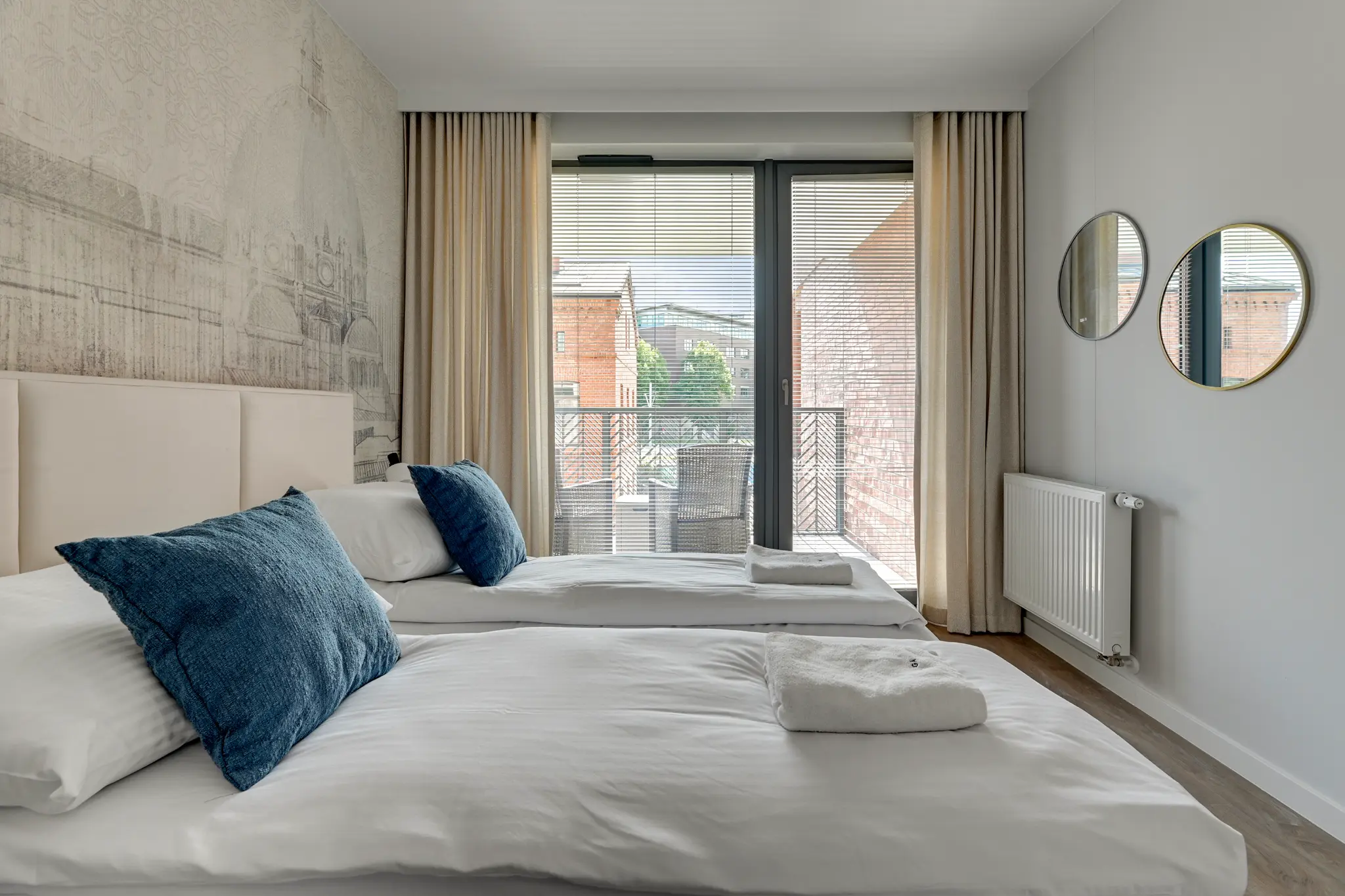
On a bedroom floor plan, two beds look promising: they can be separated for guests who want to sleep apart, or pushed together for a couple. Only once the room is furnished does it become clear whether there is space to walk between them, where the bedside table goes, and whether the wardrobe can still be opened. The fact that a piece of furniture can be moved does not, by itself, mean the apartment offers two equally convenient layouts.
Choose two single beds when you want to provide separate sleeping spaces and can confirm that this arrangement works in the actual room. If separating them blocks access to the furnishings or requires rearranging the entire bedroom every time, it is better to consider one fixed double bed than to promise flexibility that exists only on paper.
Start with the sleeping arrangement, not the number of guests
“An apartment for two” does not answer the question of how those two people will sleep. A couple may prefer to share a bed, while two people travelling together may need separate sleeping spaces. You do not have to predict who will book the apartment. It is worth deciding, however, which needs the bedroom can actually accommodate.
List the sleeping spaces separately for each room. Hypothetically, in an apartment with two bedrooms, one could have a fixed double bed and the other two single beds. This arrangement offers a choice without requiring every room to be changed. However, two beds in one bedroom are still sleeping spaces in a shared room—they do not replace two separate bedrooms if guests expect privacy.
Two mattresses do not always mean two beds
Before buying, check the construction, not just the product photo. Two mattresses placed on a single shared frame do not automatically create two beds that can be separated. Similarly, an extendable piece of furniture may still function only as one double bed when pulled out.
IKEA’s documentation provides a specific example: the manufacturer states that the HEMNES day-bed with two ÅGOTNES mattresses is not intended to be used as two single beds, but as a double bed when the base is pulled out.1 This is not an assessment of all extendable beds, but a limitation of the specified model. The takeaway for an owner is simple: confirm the stated configuration in the product details and instructions for the specific furnishings before including it in the apartment description.
Check the walkways in both arrangements
Draw up two layouts using the room’s actual dimensions and the full footprint of the bed frames. Take headboards, protruding parts and any furniture that will remain in the bedroom into account. Do not assess only whether the beds fit side by side. Check how someone using each bed can get to the door and put away their belongings.
A quick test should include:
- access to both beds without having to pass through the other sleeping space;
- opening the doors, wardrobe and drawers in both arrangements;
- access to lighting and sockets at each bed;
- space for luggage and access to the window or balcony, if there is one in the room.
Hypothetically, two beds might fit along one wall, but when separated, one could end up in front of the wardrobe. In that case, the second arrangement exists on the plan but makes everyday use of the room more difficult. It is worth catching this before interior design is finalised with furniture purchases and the placement of electrical outlets.
Confirm how the beds connect instead of assuming
If you also want to offer a combined arrangement, look for furnishings designed to be changed in this way. Hypnos describes its “zip and link” system: two separate mattresses are joined with a zip, and the bases are connected with appropriate fasteners at the head and foot. The manufacturer states that the set can be separated into two single beds.2
This is an example of an existing solution, not confirmation that any frames can be pushed together without problems. Before ordering, ask the supplier to identify compatible components and show them the plans for both arrangements. Confirm the set’s compatibility in the manufacturer’s documentation. Do not treat a mattress topper as proof that the entire set of furnishings is designed to be joined. Other furnishing mistakes are worth considering separately; here, the key question is whether the set you buy really allows both promised arrangements.
The change of arrangement must work in day-to-day operations too
Before preparing the listing, carry out a full test of the changeover. Do not stop at moving the frames: make the beds with linens, position the bedside tables and check where the items not needed for a given arrangement will go. Measure how long the whole task takes instead of estimating based on an empty room.
Also agree with the company managing the apartment who receives information about the chosen arrangement and at what point during the stay the change can be prepared. Clear arrangements, a supply of the right linens and somewhere to store them are all needed. If changing the layout requires removing a heavy headboard or dismantling other furniture, consider keeping one arrangement. Flexibility should be repeatable, not dependent on an exceptional effort before guests arrive.
Describe the actual setup and the conditions for changing it
A photo of beds pushed together does not explain whether they can be separated. Conversely, a photo of two separate beds does not confirm that a combined arrangement is available. If you offer both arrangements, show them and label each one clearly. Explain how guests can request their preferred option, in line with the actual arrangements for managing the apartment.
If there are two mattresses, do not imply that they form one continuous mattress. If the arrangement is fixed, say so clearly rather than using the general phrase “flexible bedroom”. Provide an accurate description that lets guests choose the apartment based on its actual features, not assumptions. There is no need to highlight every detail of the construction, but the difference between a shared and a separate sleeping space is relevant information when booking.
Choose a layout that can be maintained day to day
Two single beds make sense if they provide the required arrangement without blocking access to the furnishings. Choose a changeable system only after checking the documentation, walkways and the preparation required for both arrangements. One fixed double bed remains a sensible choice when it is the only comfortable arrangement for a particular bedroom. The goal is not to list as many options as possible, but to provide furnishings that match the promise.
If you are considering entrusting GrandRent with rental management, prepare a floor plan, photos of the bedroom and information about the beds you are planning to buy. Let’s discuss which arrangement is worth testing in your apartment and what needs to be agreed before preparing the listing. The initial conversation about entrusting us with rental management is free; the scope and costs of any further services are agreed individually.
Technical sources
The article explains the rules and questions you should ask the operator. Rental results and cooperation terms require analysis of the specific apartment.