
You have several successful photos of the apartment: the living room, the bed, the view from the window and a close-up of a designer lamp. Each looks good, but only one can lead the listing. Choosing the most attractive shot is not always the best way to answer a guest’s question: “Is this place right for my stay?”
How do you choose the main photo for a rental apartment listing? Choose a clear shot that shows a real feature relevant to the planned stay. It might be a shared space, a place to work or a view from inside the apartment. The décor should support that message, not replace it. The first photo does not have to tell the whole story; it should give an honest reason to take a closer look at the apartment.
Start with the guest’s needs, not your favourite interior feature
The owner remembers the time spent choosing the wallpaper, lamp or colour of the fitted units. Someone viewing the listing does not know about those decisions. They are trying to picture their own stay, so it is worth first identifying what the apartment genuinely makes easier.
Imagine an apartment prepared for a family, with a comfortable table and space to relax together. A photo showing both features may meet their needs better than a close-up of an elegant bathroom tap. In a hypothetical apartment intended mainly for stays by couples, a stronger opening image might be the bedroom or a lounge area with an attractive view.
This does not mean guessing who every guest will be. It means highlighting the kind of stay the apartment is well equipped for. If you cannot name such a benefit, start by clarifying the assumptions behind the listing rather than looking for a more striking photo.
Show one standout feature in context
A good opening photo has a clear subject. It does not have to be minimalist, but viewers should understand what they are looking at. If the standout feature is the view, show it alongside part of the interior. A landscape on its own does not tell you whether you are seeing the view from the apartment or an attraction nearby.
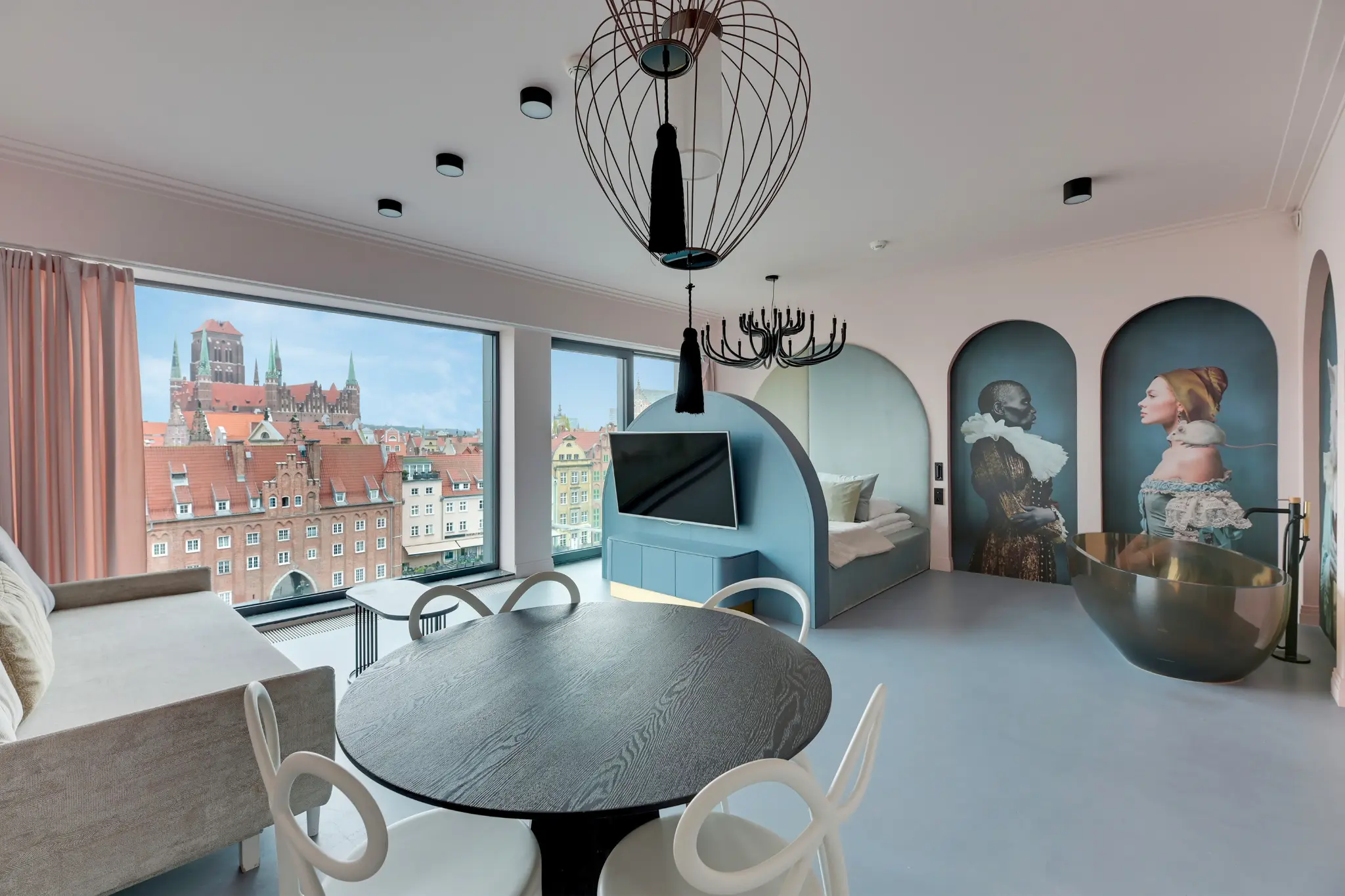
The illustrative photo shows Gdańsk’s historic buildings through large windows, along with a table and a lounge area. It is a good starting point for thinking about how to choose a shot: the view is shown in the context of the living space. The interior also has distinctive decorative features, but they do not need to be the listing’s only selling point.
If the apartment’s real advantage is a comfortable living room, do not try to squeeze the entire apartment into the first shot. It is better to show how the sofa, table and available space relate to each other than to include lots of small details whose significance is hard to read.
Check the photo at thumbnail size, not just as a full-size file
View the candidates at a small size. Can you still make out the main advantage? Does a bright window overwhelm the rest of the interior? Is an important feature disappearing at the edge? This is a practical test of clarity, not an assessment of the photo’s artistic merit.
Check the format where the listing will appear. Airbnb says in its Help Centre that search-result photos are displayed horizontally and recommends images in that orientation.1 Do not treat this as a universal rule for every channel, though. Also preview the specific listing on a phone.
If, once the photo is reduced, all that remains is the lamp or part of a curtain while the table or view disappears, the shot is not conveying the benefit you chose to highlight. In that case, it is better to choose a different image than to try to rescue the message with the title alone.
Do not let the photo promise more than the apartment can deliver
A wide-angle shot helps viewers understand the space, but it should not suggest proportions that guests will not find in reality. Similarly, a photo of a workspace does not confirm the quality of the internet connection, and a balcony photo does not tell you whether the surroundings are quiet. Assess separately what is visible and what needs to be clearly explained.
Imagine a table that looks comfortable for several people, but when the sofa is unfolded, the space to walk past it becomes cramped. A photo of the daytime layout may still be accurate, but it should not replace information about how the apartment can be used. It is worth explaining details like these in a clear and accurate description, rather than trying to fit every answer into a single image.
Also check whether the furnishings shown will be available during the stay. A temporary armchair or a table set up just for the photo shoot should not create an expectation that will later go unmet.
Prepare the space without changing its character
Before the photo shoot, remove stray items, tidy cables and arrange the furnishings as they will be used. Airbnb recommends using natural light, opening the curtains and composing the shot thoughtfully with the camera at eye level.2 These are tips for showing the interior clearly, not a reason to hide its limitations.
If the main function remains out of sight despite several attempts, the problem may be the furniture arrangement. A table hidden behind the sofa or a workspace blocked by decorations is hard to show convincingly. It may be worth considering interior design with the way the space will be used in mind. Improve the function first, then photograph it.
Compare shots using the same criteria
Compare two or three shots taken at a similar stage of preparing the apartment. Ask the same questions about each one:
- What guest need does this photo help them assess?
- Does the most important feature remain clear when the image is reduced?
- Does the shot show the actual furnishings and realistic proportions?
- Is it clear what makes this apartment stand out without an explanation?
You can ask someone who does not know the apartment to say what they remember. If they mention the décor when you wanted to show a comfortable shared space, that gives you a specific reason to change your choice. This test does not predict bookings; it helps you check whether the message is clear.
Discuss the photo in the context of the specific apartment
The opening shot is part of how the listing is presented. It should match the actual furnishings, description and the needs of the guests the apartment can serve well. It does not need an exaggerated promise or an effect that distracts from the space.
If you are considering entrusting GrandRent with rental management, let’s talk about your apartment and which of its advantages are worth showing first. The initial conversation about entrusting us with managing the apartment is free of charge. You can bring a few photos and tell us how you plan to use the apartment — that will give us a concrete starting point for discussing working together.
Technical sources
The article explains the rules and questions you should ask the operator. Rental results and cooperation terms require analysis of the specific apartment.