
The owner of a small apartment looks at the photos after the shoot and sees a spacious room. But when they stand beside the bed, the interior feels much more cramped. This is a good time to check not only the photos’ aesthetics, but also whether the framing helps viewers understand the apartment’s actual layout.
How can you show the true size of a small apartment in photos? Keep the furniture in full view, along with its relationship to the walls and the routes guests use to move around. Choose a perspective that does not make the bed look enormous in the foreground or turn a short passage into a long corridor. A photo cannot replace measurements, but it can honestly show how the space is arranged.
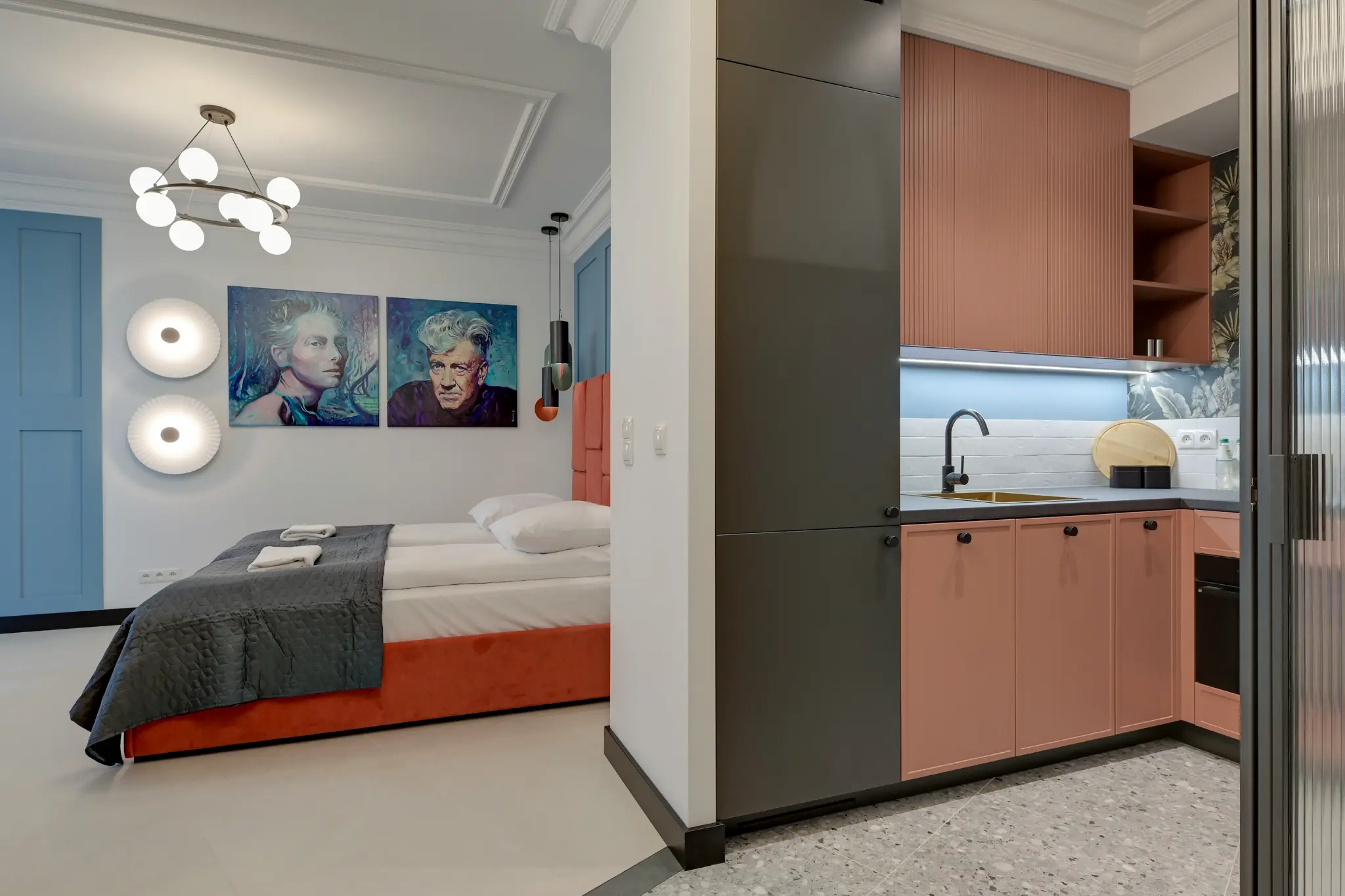
Show the Boundaries of the Space, Not Just Its Center
A patch of floor between the sofa and the coffee table says little about the size of a room. What matters more is where the sofa ends, how close the table is, and whether there is room to pass beside it. In a small apartment, these relationships are precisely what should be made clear.
When photographing the living area, look for a shot that shows at least two related elements: for example, the entire sofa and the adjacent wall, or the table and the passage to the kitchenette. There is no need to fit the whole room into a single photo at all costs. It is better to show a smaller section with clear boundaries than a wide view in which distances are hard to make out.
Decorative details still have a place in the listing. They should not, however, replace shots that show how much space the furnishings occupy.
A Wide-Angle Lens Is a Tool, Not a Way to Add Square Metres
A wide-angle lens helps capture an interior, but not every such shot will be suitable. In its official material, Canon notes that a wide angle can alter architectural proportions and create the impression of more space. It also stresses the need to preserve the actual geometry of the place being photographed.1
This does not mean wide-angle lenses are forbidden or that you have to buy specific equipment. Assess the result: does the armchair at the edge of the frame look unnaturally wide? Does the bed retain a recognizable shape? Does the fitted furniture look like an expanding fan?
If a photo raises these concerns, ask for the camera to be repositioned or for a less wide-angle shot. A more restrained frame, even one that captures less of the interior, is a better choice than a photo suggesting space that is not actually there.
Furniture Helps Show Scale When It Is Fully Visible
A bed, table, and chair are familiar points of reference, but they are not measuring tools. Without knowing their dimensions, you cannot reliably calculate a room’s width from a photo. You can, however, assess how the furniture is arranged in relation to one another.
So show not only the headboard and bedding, but also the side and foot of the bed. At the table, keep the chairs and the area around the tabletop in view. A frame cropped exactly at the edge of the mattress may conceal how close it is to the wall; a shot of the tabletop alone does not explain where another person would sit.
Imagine a hypothetical apartment with a bed positioned close to the kitchenette. An attractive detail of the headboard can remain in the listing materials, but there should also be a shot showing both elements together. That way, viewers understand how close they are to each other instead of imagining a separate bedroom.
Show the Passage as Part of the Interior
The owner knows the route from the entrance to the wardrobe. Someone viewing the listing is only just discovering it. That is why it is worth leaving some floor space around the furniture, the entrance to the adjacent area, and the space in front of fitted furniture in the frame.
Preparing for a photo shoot should not mean removing chairs that will later be put back in a narrow passage. Tidy up and remove stray items, but photograph the furnishings in their intended arrangement. If the apartment will be rented with a particular table and sofa, the photos should show that exact setup.
In a hypothetical room with a sofa bed, you can take an additional shot with it unfolded. This shows what happens to the passage in the sleeping configuration. It is not a question of photo order, but of honestly showing the space a guest will use.
Do Not Change the Apartment’s Layout Through Cropping Alone
When choosing a crop, check what disappears beyond its edges. Removing a section of empty ceiling can make the composition neater. Cutting off the only visible passage or the entire foot of the bed can deprive viewers of important information.
Treat editing in the same way. Adjusting brightness or correcting vertical lines should make the image clearer, not serve to make the room look wider. If a chair looks different from reality after editing, it is worth going back to the original and finding out with the photographer where the proportions changed.
Photos do not have to explain every dimension on their own. Information about floor area and layout is complemented by a reliable description. However, you should not expect an accurate description to fix a misleading frame.
Assess the Photos from a Future Guest’s Perspective
Before approving the materials, view them in the apartment, preferably on a phone. Compare each photo with what you see in front of you. The aim is not to create an identical visual impression, but to avoid surprises caused by hidden boundaries.
Three questions can help:
- Can you see where the main pieces of furniture end?
- Can you identify the passages between the functional areas?
- Does the shot suggest a separate room where there is actually a shared space?
If the answer requires a long explanation, ask for an additional shot. An honest listing presentation does not mean highlighting only the limitations. It means showing the advantages in a way that helps viewers understand their actual context.
If the Problem Is the Layout, Change the Interior, Not the Image
If the photo still shows an inconvenient layout once the passages are visible, it is worth taking a closer look at the furnishings. An oversized coffee table or an unnecessary chair is a matter for interior design, not retouching. A photograph should document an improvement, not take its place.
Do you own a small apartment in Trójmiasto and are wondering how to prepare it for rental? Talk to GrandRent about the specific apartment, its layout, and the materials for its listing. The initial conversation about entrusting us with rental management is free and non-binding; the scope and costs of any further work require a separate agreement.
Technical sources
The article explains the rules and questions you should ask the operator. Rental results and cooperation terms require analysis of the specific apartment.