
You’re viewing a ground-floor apartment. The seller points out a door leading directly from the pavement and presents it as an advantage for rental. No lift, no need to go through the stairwell, close to the exit. Before paying extra for this feature, however, check what is happening on both sides of the door.
An apartment with a separate street entrance may suit your rental plan if it offers convenient access with luggage, sufficient privacy, and clearly defined responsibilities for maintaining the entrance. The mere absence of a shared corridor does not determine whether a stay will be comfortable. What matters more is whether guests can use the apartment freely and whether the owner understands the limitations and costs of this arrangement.
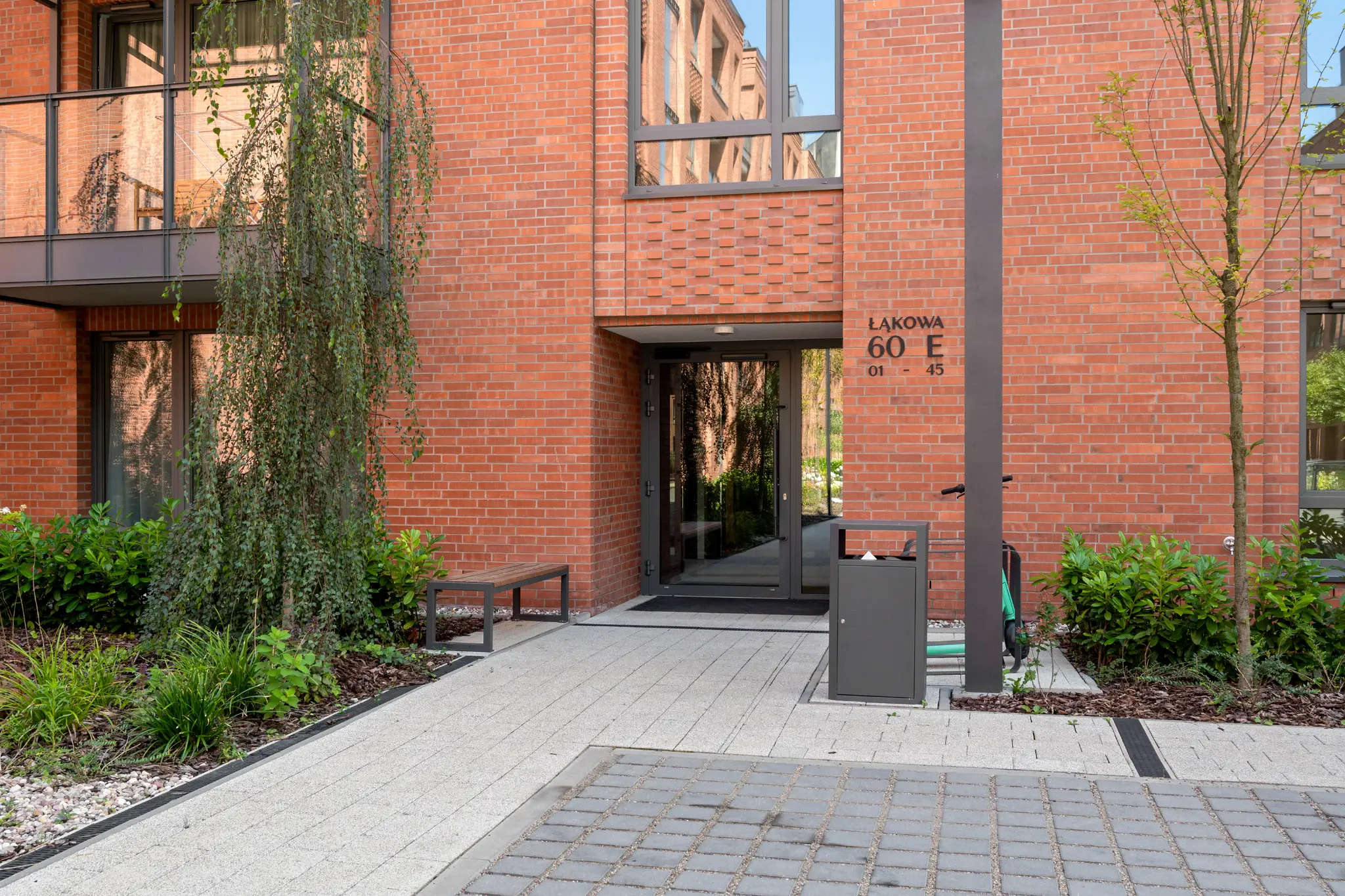
Illustrative photo: entrance to the Scala building on Łąkowa, not an example of a separate entrance to an apartment.
What does the seller mean by a separate entrance?
Establish whether the door leads exclusively to the apartment or to a shared vestibule. Also check whether the access route runs along a public pavement, through communal property, or across another property. These are different situations, even though each might be described similarly in a listing. Ask to be shown the route and the documents establishing the right to use it.
The appearance of the entrance does not replace checking the designated use of the premises. According to GUNB guidance, an assessment of a change in the manner of use concerns, among other things, activities that change fire-safety or hygiene and sanitary conditions 1. This does not mean that every rental requires such a procedure. If the documents and planned use raise questions, clarify them with an appropriate specialist before buying. A broader pre-purchase inspection is worth carrying out regardless of how attractive the door itself may be.
Check privacy from the pavement and from the sofa
During the viewing, one person should stay outside while the other sits where you plan to put the table, sofa, or bed. Check what is visible through the glazing and when the door is open. Can passers-by see only the hallway, or the living area straight away? Is the entrance beside a spot where people tend to stop for a while?
It is worth coming back after dark to see how visible the interior is with the lights on. Don’t assume curtains will solve everything. If they need to stay closed all the time to ensure privacy, consider whether that way of using the apartment suits your intended guest group—especially if all the windows face the same pavement.
Distinguish between a problem that can be improved through the layout and a permanent feature of the location. Moving the table may reduce residents’ exposure to passers-by. You can’t eliminate heavy foot traffic right outside the door by rearranging the furniture.
Walk the entire route with luggage
A short distance from the street does not always mean easy access. Check the route from the place where someone can actually get out of a vehicle all the way to the interior. Pay attention to uneven surfaces, steps, the width of the passage, and the space needed to open the door. Don’t assume a car will be able to stop directly in front of the apartment.
During your visit, walk this route with a suitcase, with the seller’s permission. See where you can put your bag while opening the door, and whether another person can stand beside you without blocking the pavement. If you’re considering family stays, also allow space to manoeuvre a pushchair.
Don’t equate a ground-floor location with full accessibility. For example, when confirming step-free access, Airbnb requires photos of the entire route from the guest’s arrival point to the entrance, with the threshold visible 2. This is a platform requirement, not an accessibility certificate for the apartment. Before buying, it is therefore worth collecting photos and measurements rather than relying on the word “ground-floor” in a future listing.
Check the door from the inside too
Close the door and listen to the surroundings. Then check what you can hear from the planned bedroom. One quiet visit does not give you the full picture: if there is a business next door or a delivery area nearby, arrange another viewing at a different time.
Inspect the threshold, door frame, and floor by the entrance. Ask the seller for the door’s documentation, details of previous repairs, and any reports concerning this area. A mark on the threshold does not in itself prove there is a defect. A professional should assess any concerns about airtightness, the structure, or fire protection. Don’t plan to replace the door or rebuild the entrance without checking what is possible and which approvals are required.
Who is responsible for the area outside the door?
Before buying, establish with the property manager and seller who is responsible for keeping the access route clean, lighting it, and maintaining the entrance components. Don’t infer how responsibilities are divided solely from the fact that the door serves one apartment. Ask what the work actually involves and how it is accounted for, and confirm the arrangements in the documents.
Think about the day-to-day preparation of the apartment too. Where will the cleaning staff put the equipment they need? Does the entrance need extra cleaning after rain? Is there room for a doormat on the appropriate side of the door? Write down these requirements instead of assuming they will disappear once the apartment is handed over to an operator.
When agreeing on guest services, distinguish tasks relating to the apartment from work on communal property. The scope of services, costs, and GrandRent’s responsibilities are agreed individually; having a separate entrance does not automatically extend them.
Compare two apartments using the same criteria
Consider, hypothetically, two apartments of a similar size. The first has a street-facing door, but it opens directly onto the sleeping area. The second requires going through a shared corridor, but has a separate hallway. If you are planning stays that involve working at a table and needing privacy, the shorter route to the first apartment may not outweigh the layout of the second.
Before deciding, write down three answers:
- What does the separate entrance actually make easier for my rental plan?
- Which inconveniences can I address, and at what agreed cost?
- What limitations will I have to live with in the day-to-day use of the apartment?
Make your decision before you start preparing the apartment
A good reason to buy is an entrance whose advantages you have confirmed in person and whose associated responsibilities you can clearly assign. Unclear documents or the need for a rebuild whose feasibility has not been checked are reasons to put the decision on hold. A separate guide on late guest arrivals covers how to arrange access handover; it does not replace an assessment of the property itself.
Have you found a specific apartment in Trójmiasto? Talk to GrandRent about the entrance layout and your plan for managing the apartment. The initial conversation about entrusting rental management is free of charge. If you need a broader pre-purchase assessment, a separate investment analysis is a paid service with scope agreed individually.
Technical sources
The article explains the rules and questions you should ask the operator. Rental results and cooperation terms require analysis of the specific apartment.