
An owner views a waterside apartment and sees a restaurant almost directly opposite on the map. It is easy to assume that a guest can simply leave the building and cross to the other bank. Before buying or preparing a listing, however, it is worth asking a different question: exactly which way will they go, and what will they do if the chosen crossing is unavailable?
The best way to verify a walking route from an apartment across Gdańsk’s bridges and footbridges is to check it from the actual building exit to a specific destination. Walk the entire route, check the conditions for using each crossing, and identify a second option. Neither the distance on a map nor a single walk justifies promising a fixed walking time.
Start at the building exit, not the map pin
The address pin is a point of reference. To check the route, you need the actual exit that guests will use. Then choose a specific destination: a museum entrance, an agreed meeting point or a stop. “The city centre” is too vague to compare two waterside locations.
Set the map to walking directions and review each section of the route. Note the names of the crossings, not just the total distance. Check whether the route leads directly to the right bank or first requires crossing an island and then crossing the water again. These are the connections that you will need to verify on the ground.
Do not choose only a destination that can be reached from the apartment by the most convenient shortcut. For an apartment offered to different kinds of guests, it is also useful to consider everyday destinations: places to shop and routes towards onward travel.
Identify the crossing and its restrictions
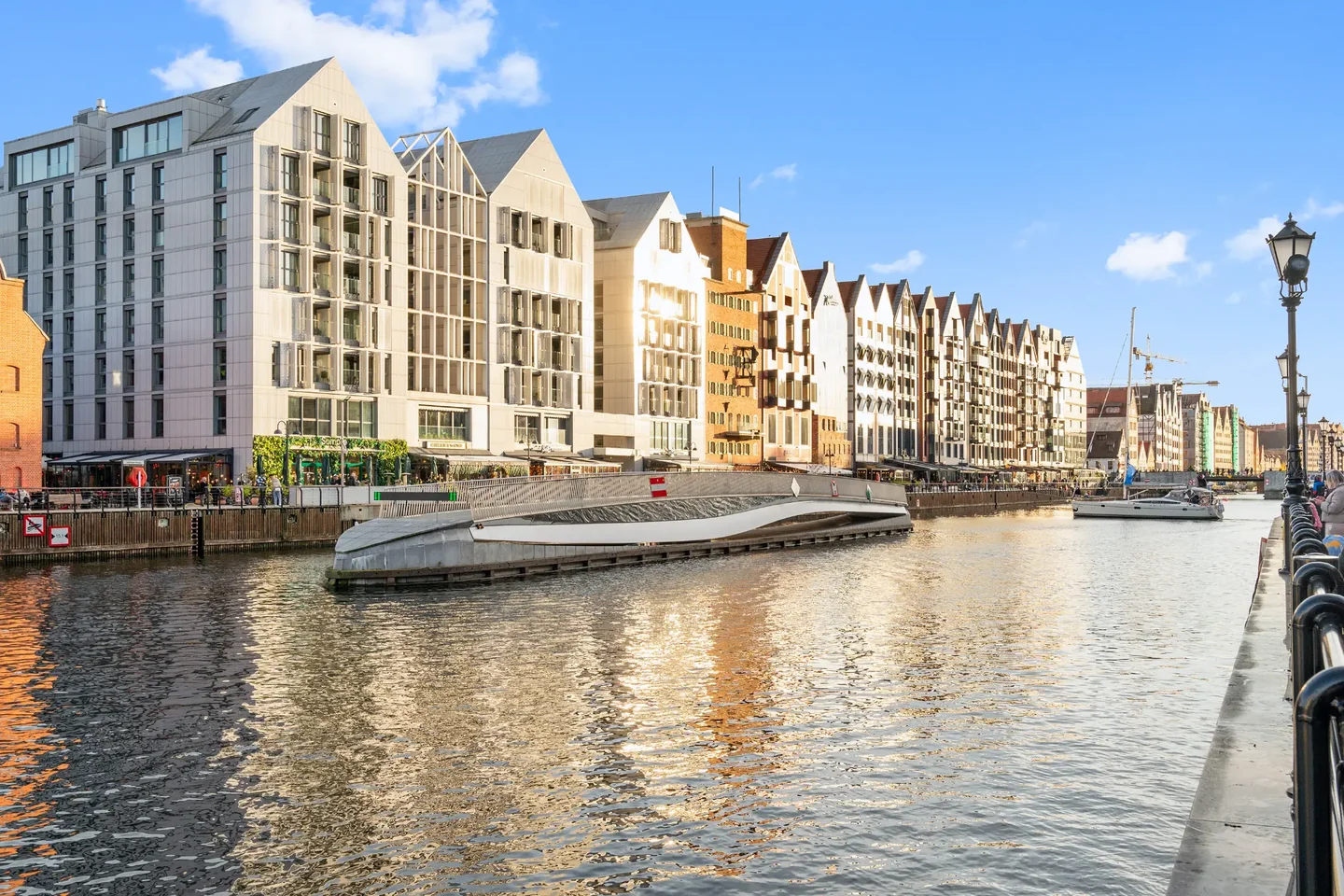
The footbridge is not always open for pedestrians. Gdańsk Roads Authority publishes information about the opening of the footbridge to Ołowianka, including openings requested by vessels. A pedestrian route should therefore be considered alongside the crossing’s operating conditions, not treated as an unconditional shortcut. 1
Another example is the pedestrian footbridge linking Długie Pobrzeże, at the level of św. Ducha Street, with Granary Island. A city notice describes its rotating span, which opens to allow vessels through. This is a different crossing from the footbridge to Ołowianka; in guest instructions, it is worth distinguishing them by name and location. 2
For every movable crossing, check the operator’s information and the signs on site. Do not copy into the listing a schedule you once found online and treat it as permanent. If the notices are unclear, confirm the conditions with the operator rather than deciding for yourself which information applies.
Walk the entire route in both directions
Start your route check at the building exit and finish only when you reach the entrance to your chosen destination. Pay attention to whether the route is continuous: after leaving the footbridge, can you continue along the indicated waterfront, or do you need to turn and walk to the next crossing? Do not assess a section solely on the basis that you can see the destination across the water.
On the return journey, check whether the same directions are still easy to follow. A guest returning in the evening will be looking for different landmarks from someone viewing the route from the apartment window. It is worth checking the route at a time close to the expected arrival, but do not treat that one visit as confirmation that it will be accessible on every date.
After your walk, note what you actually checked. Distinguish between “we walked this way during the viewing” and “check the crossing conditions before setting out”.
Plan an alternative before you need one
The alternative route should lead to the same destination while avoiding the crossing on which the shortcut depends. Simply drawing a different line on the map is not enough: check that the alternative does not use another crossing requiring the same kind of verification. Walk the alternative route too, and describe it in both directions.
A short note about the apartment only needs four things:
- the actual building exit and the exact destination;
- the name of the crossing on the main route;
- where to check the latest crossing conditions;
- a verified alternative route that avoids that crossing.
If you have not been able to verify the alternative, do not present it as a ready-to-use option. The owner should know about this gap before writing the listing, not only after a guest asks.
Assess the location from a guest’s perspective
Imagine two apartments being considered. From the first, the route to the chosen destination goes over a movable footbridge. From the second, the route is less direct, but the verified alternative does not use that crossing. This is a hypothetical comparison: the first apartment’s proximity alone does not mean it will be more convenient for every guest.
For someone planning a leisurely walk, a wait may be acceptable. If they are heading to an event at a set time, it is worth pointing out an alternative route that avoids the movable crossing from the outset. The point is not to rule out an apartment on the Motława, but to tailor the information to how the location will be used.
Similarly, when viewing apartments in Brabank, assess the route from a specific building to a specific destination. The development’s name is no substitute for checking the route, and a waterfront photo does not show all the connections guests may need.
Describe the route instead of promising a walking time
A location description should answer “which way?”, not just “how close?”. A hypothetical set of instructions might say: “The main route goes over the footbridge indicated. Check the crossing conditions before setting out; we have described an alternative route via another verified crossing separately.” Fill in the names only after checking the specific apartment.
The guide to creating a reliable description covers how to prepare the full listing. Here, the most important thing is to ensure that information about the route across the water is consistent in the listing and the guest instructions. If the pedestrian route changes, update both, rather than leaving guests with conflicting directions.
Prepare specific questions before discussing management
Before discussing management in Gdańsk, gather the address, destinations for walking trips and notes on both routes. Ask how guest information will be prepared and updated within the agreed scope of cooperation. This material makes it possible to discuss the actual apartment without reducing its advantages to the generic phrase “on the Motława”.
If you are considering entrusting your apartment to GrandRent, we invite you to a non-binding conversation about the specific address and your rental-management needs. The initial conversation about entrusting us with management is free of charge; separate analyses and other services are paid services, with their scope agreed individually.
Technical sources
The article explains the rules and questions you should ask the operator. Rental results and cooperation terms require analysis of the specific apartment.